Splits

Yeah. Those. Couple things here. Currently, I have a split superior to any that I’m aware of in the industry (other than 100%-Because-I-Own-The-Firm Split, but one could assert that you would then have more expenses than I do). While that may seem like the golden goal for every new agent, I’m not convinced that’s true.

My split now is 90/10 with a $6,000 cap. There’s a transaction fee of 0.085% of the selling price of every side. That’s it. I have some (former) colleagues who complained that when you’re doing $20m+ of deals in a calendar year, that transaction fee matters a lot. Anything sub-$15m in volume though and it’s not really a huge deal for most people.

So, what do I get for that little bit of money? Not much. I have a broker of record. I have a Broker-in-Charge that I can call for help with big stuff that I don’t know how to field myself. There are some physical office spaces throughout the states that we’re active in. There’s a main HQ with an accounting/compliance team (helpful), and some marketing folks that don’t really affect me one way or the other. There’s a subscription to kVCore that I don’t really use. And E&O. That’s pretty much it.

I like this setup because I’ve been selling real estate for a while, know what I’m doing, and feel comfortable working autonomously. Beginning in a situation like this though, I think, is a horrible idea.

Here’s why:

There’s very little, if any, effort made to train new agents. There are some checkbox processes they have, but mostly you’re on your own. No office meetings, no mentorship, no real education. For me, in the beginning, that mattered a hell of a lot. They had no processes where I started (to speak of) other than latching onto someone.

I shadowed (I followed him everywhere I could) one of the top-producing, slick-talking, stud brokers in our area for my first 6-12 months. I rode with him, went on appointments with him, and worked for him (for free, even though he made me think I would earn money somehow). It was all a part of my education (way more valuable than money, in hindsight). I’d linger around his office. I’d stay late and he would often be there late too. It was good. It mattered.

I eventually left primarily because of the money. That, and because I felt like I couldn’t trust this guy that I was just describing. That’s a more complicated situation to explain, but it would be dishonest to ignore that it played a role in my leaving the firm.

At the time, that firm was taking 50% of everything I made. I had no idea how lousy that was until I found out I could make 75% with a $15,000 cap down the street (where I still hang my license). I couldn’t imagine how much money that was — what a difference!

Well, less than a year after I got to the company they cranked up the compensation plan to what I previously described, and I was even more happy about my decision.

But I’d be lying if I said I didn’t miss some of that comradery and contact we had in that office. My business partner began in that same firm working with that same man. We both miss it. But, we’ve come together and formed our own company (team), in part, so we can have that again by working together.

Not only is this a lonely business, but in the beginning, it’s so important to have people to model ourselves after. I still think it’s important for me to have that, and it’s an area that’s lacking for me and has been for a while. We’ve considered changing firms for that reason and may still — even at the cost of $5k-$10k per year in splits.

Little has done more to enhance my career (and my life) than learning, and one of the most immediate, effective, and thorough ways to learn is from people that you work with.

So, before you sign up for a cloud firm with people ALL OVER THE WORLD to support you, consider that it might be more advantageous for you (not to mention that it may increase the odds of you surviving in the industry) to join a team or firm that’s local to you (and has “culture” or at least people that give a shit about your success). It matters to have that level of support. I’ve seen countless people join my firm and office in the last several years who are no longer real estate professionals.

It’s a people business, but we’re people too. I’m an introverted computer nerd that happens to be moderately attractive and can talk 1-on-1 well enough to sell some shit. I hate rooms, I hate parties, I’m not that slick. I’d much rather be reading a book than be at your BBQ, and when I get home from your BBQ I want to lock myself in my house for two days to decompress. And I’m here to say that for me it was absolutely critical to be around people (and successful people at that) early on, and perhaps still.
Splits

High Stress, High Stakes

Dealing with difficult people during difficult times is unfortunately something that characterizes the role of the real estate professional. High stress, high stakes. And let’s be honest, sometimes the situations themselves don’t really seem that intense.

Looking at a $400k condo +/- negotiating an extension deadline for a financing contingency and a closing. Big fucking deal.

But in reality, the sellers I represent already got buyers to the closing before the buyer breached contract and bailed. Here we are, sold it again, made it to the eleventh hour, and the buyer agent is requesting a second extension of the financing deadline.

If that were all, it would be annoying, maybe frustrating. Add to these kinds of situations marital separations, pending foreclosure and auction, looming bankruptcy, or loss of job or loved one — suddenly, these apparently basic situations and negotiations are incredibly high stress, high stakes.

And it’s our job to show up. To stay even-keeled. To be the objective one that has their shit together and also knows what’s going on so we can manage the situation as best we can.

Takes practice. But we get better at it. We get better at recognizing what’s our ego and what’s actually in the best interest of the client. What needs to be said, what should be said, what doesn’t need to be said, and what shouldn’t be said. We learn to let ourselves have fun with the draft email but delete most of it and wait until the morning to revise it again if needed and actually send it.

This is one of the skills that makes us good at what we do. It’s where we can be of immense value or significant detriment to the people we serve.

High Stress, High Stakes

Did I mention follow up?

There’s a guy who I’ve been calling every week for a while. What’s most surprising to me is that he’s never once been like, “Why are you calling me every week?”. It’s always been a little update even when he’s really saying nothing new.

I’d love to say that I’m just that diligent. I’m not. My client is. I have a buyer client that I represent only in this purchase (which may never happen), and he sends me a gentle text every week on the day that I say I’ll follow up with the seller again.

This began as an invitation to list the property. It’s an 11-unit apartment building in a small town near where I live. I prepared a market analysis without having seen the units, just to give him a down-and-dirty estimate of the value to begin with.

He went cold after we went back and forth a couple of times. I kept on him a bit but my spirits were flagging after about a month or two of checking in.

Then I met Mr. Buyer. He reached out to me cold after finding me on LoopNet, asking if I had any buildings like this one. I told him that I might have a listing coming on with 11 units in it and that it sounds like it would fit what he was looking for quite well actually.

Now I get to call the seller with a purpose! I have a buyer. He listened, intrigued, and asked if this guy had mailed him. He was fascinated that people actually wanted to buy buildings like this now (it had been owned by his LLC and others he owned and partnered on since the late ’70s).

Then he abruptly ended the conversation by saying something similar to “uh-huh, right, right, right, okay. Okay. Good. Sounds good. Good. Yup. See ya later. Bye,” all in fairly quick succession without me saying anything other than “bye” at the end. It’s one way to end a conversation. (It’s also the way he ends every phone conversation, I’ve since learned.)

Fast forward a week. I call again. Little update. Has some other buyers who might be interested (that mailed him last year and who he called). Okay.

My guy decided to submit an offer. Now he’s contractually my guy (on this place anyway). Seller invites me over to see the units. Things are looking promising.

I look at the units. I offer feedback. I inquire about the offer. They express interest but nothing concrete. Still thinking about it.

Another week. I call. Similar thing. The other buyer is working on getting more buyers to partner. Still interested in our offer (but it’s low), just want to see how much they can get for it. Don’t want to expose it to the market because then the tenants will know. That could be messy.

Okay. Next week. I call again.

Gotten keys from some of the units. Many of them are nicer than the ones I saw in person. There’s a lot of potential here. Do I have any idea about building code in this town as it relates to second form of egress? No? Okay. Still thinking about it. Buyers are still trying to find other partners. Bye.

This went on and has gone on now for five months, maybe six?

Every week, I put a new task in my calendar to call this guy. Every week, my client texts me and asks for an update.

Today was that day of the week. I called. Voicemail. I had a challenging day today (as well as yesterday). It’s the end of my day. He calls back. I answer. One of the first things he says is he asks me what the listing fee is. I know where this is going! I answer adeptly and I explain that that includes buyer agency as well. He asks a clarifying question. I explain. Finally! I’ve been at this stupid thing altogether since January (August 29th today), and calling weekly for close to four or five months. I’ve had a tough couple days baby, but this is going to make it all worth it!

He next asks if I know why his buyers backed out.

I say that I don’t. He explains various things regarding the width of one of the stairwells, that there’s a support beam too close to a header and they’ve taken water there before, and something he wasn’t sure about concerning the foundation.

I listen and make understanding noises as he talks.

After 10 minutes of this, he says they still have a lot to think about. He makes no committal indications of anything.

Well, it would have been nice…

What did I do? Cry into my keyboard and wish that my fucking day would lighten just a little bit?

I set the reminder to call him next week.

Did I mention follow up?

Things will be golden…

Days like this happen. I have buyer clients interested in a listing of mine that’s for sale off-market. They were hot and all over it when I showed it to them Wednesday, but they’re exploring working with a lender who’s a family friend—meeting with him on Thursday.

The meeting happened, and there was some issue, they said, but they expected to know more Friday, or Monday morning at the latest. I texted Friday morning. No response. Saturday. No response. Again this morning, asking if I should instead call.

They finally responded saying that it was a difficult weekend and that they’ve not heard back yet…. I asked what the issue is. Is the lender not getting back to them? No response. Not my lender. There’s none of this with my lender, and it’s questionable whether this is true even with their lender.

What else? Another new buyer client who’s planning to relocate to this area next year replied to an email about a property in a terse way, explaining that they’re not interested in making a move yet, “as you know”. They specifically inquired about this property and told me to let them know about any others that came to the market.

What else? My assistant sent the wrong signed addendum — one that I was withholding for negotiations — to the lender and the title rep. This is on another deal for a listing I have. That was yesterday. Today, I got the right addendum back, signed, and was excited to have gotten a more favorable closing date for my clients, despite the confusion and mistakes made. The title rep, not an hour later, emails “breaking news” about the HOA contacting her about two compliance issues with the exterior of the unit that need to be resolved before closing. No problem.

She also mentioned that the mortgage payoff can’t be acquired before our newly established closing date because the lender takes two days to “input” payoff requests and five business days to process them. Closing will necessarily be delayed after I jumped through hoops of fire to get it shortened. These sellers already sold the home once and had a buyer walk at the final walk-through. There are other familial and legal issues that are further aggravating the sale. A doozy indeed.

New buyers I was referred were preparing to make an offer on a property today. I spent time on the phone last night (Sunday) and again today working through the details. I coordinated with my colleague who represents the listing. Got everything prepped. The buyer let me know that the buyer’s wife “talked herself out of this one” such that they would like me to instead set up a search for “my part of the state” so that I can make some “$$” if I end up “finding them something”.

I don’t say all this to complain (yes I do, but that’s only part of the point). I write it all out to illustrate that these days happen. It happens to be a Monday. For me, oftentimes, these things don’t happen in isolation. They happen in bunches like this. I get the shit kicked out of me, proverbially speaking.

But what’s important to remember is that these things are just that—things. They’re circumstances that are outside of my control. What’s inside my control? My responses to all these situations. I don’t respond to them all perfectly and diplomatically. I might have a little bit of unprofessional snark with the title rep who inadvertently sounded the alarms on something with her “breaking news” comment that added insult to injury in an already tumultuous and difficult transaction. I asked follow-up questions to each of the buyers who flaked in various ways within hours of each other — almost as though they were all conspiring against me!

But the important thing for me to remember is that this is part of the deal. I have days when the stars align and everything goes my way. I have days when it goes the other way. And, fortunately, I mostly have days that are somewhere in the middle. It’s all material. It’s all part of the job. It’s all part of life.

If I can take it easy on myself and not delude myself into thinking that these apparent negative results are a consequence of my actions or inactions — that they’re indications of my worth both as a professional and as a person — I’ll be okay. Take the punches as they come, and grab the opportunities when they come too.

It’s a difficult business to be in. It’s an even more difficult business to stay in. Keeping our heads on our shoulders is more than half the battle sometimes. Just make it through this day. One day at a time. Survive. When they quit and go get a “real” job, you take care of yourself, take a breather if you need to, and come back and do your work.

It’ll boomerang back and things will be golden.

Things will be golden…

Keeping in touch

You never know who your next customer is going to be. We meet people from all walks of life doing real estate. Furthermore, we frequently encounter people we peripherally know from the place we live who end up working with us.

It’s not uncommon to have a direct buyer call when we have a house for sale. That’s one of the many benefits of having listings. A buyer called me on a listing I had several months ago. I sold this house, not to them, and made it a point to keep in touch.

They were somewhat far away and were a bit wishy-washy about whether they wanted to buy or rent, and if they were going to buy, whether it would be near them or near me. I don’t do much in the way of rentals, but I happened to get a house rental to market that I did as a favor to someone in order to build the relationship. The house loosely fit what they were looking for. So, I reached out to them and just let them know that it was available. Turns out they were out of the country on vacation and couldn’t see it. I offered to do a virtual tour, but they weren’t totally into it. Fine. I leased it to someone else and moved on.

Fast forward another month or two and I’m interviewing for a listing in the same neighborhood as the listing I had earlier in the year. Turns out, this seller really likes the idea of selling off-market rather than going through the hubbub of bringing it to market. They have a work-related situation and they’d rather not have to explain the move prematurely.

I won the listing. Part of what won me the listing was being able to honestly say that I had at least one, and more like three, interested buyers who might be a fit. If they happen to be, this would solve the sellers’ problem and allow them to sell it privately without having to list it publicly for sale. There is the added bonus that it could be a direct buyer and I would double-side the sale. That’s $500,000 @ 6% vs. 3.5%. Not a trivial difference in terms of commission if it all went that way.

Today I brought that buyer through the house. This was our first time meeting in person. It was a good showing and a good meeting. Established good rapport with their family. Very positive. They first called in March. It’ll be September 1st in a few days. They may buy this house, or they may not.

In either case, I’m creating opportunity. We’re so fortunate in real estate because there is so much potential for opportunity. We sell a service that is consumed by a significant portion of the population everywhere. Consequently, there is an abundance of opportunity for business hiding everywhere you look.

I wonder about how many deals I didn’t close because I didn’t keep in touch with everyone that I met. I know it’s a massive number.

The importance of a functional CRM—that we actually use—can’t be overstated, in my opinion, and it’s something I could do a lot better with. But I do keep simple lists of people so I can glance at them and see everyone that’s currently relevant in terms of now business and who I should be touching.

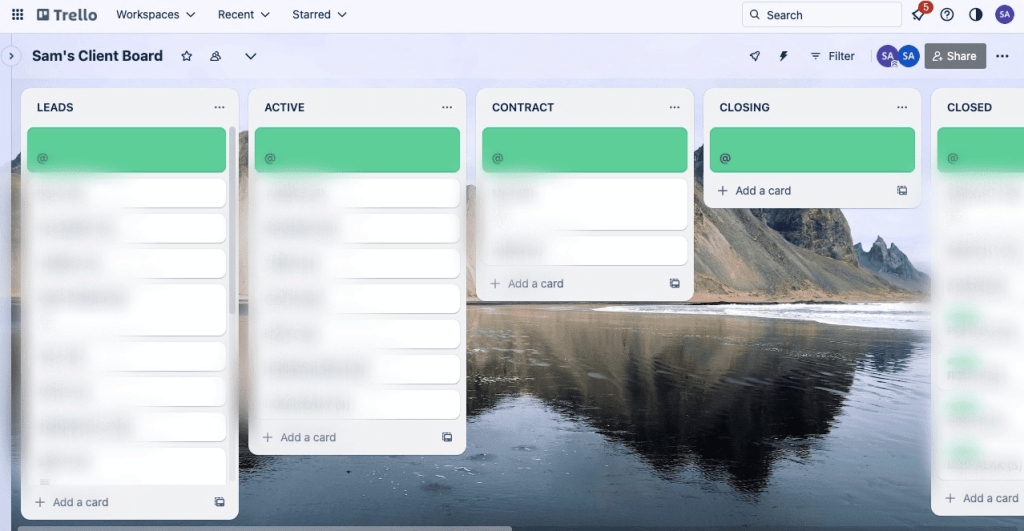
Leads | Active | Contract | Closing | Closed | Let Go | Lost/Didn’t Keep in Touch

I have these categories on a KanBan-style board in Trello like the photo below. When they change stages, I just drag them to the appropriate card (column).

This basic tool is simple enough that I do it pretty consistently. I can glance at this while I’m driving (I’m not perfect), or easily add someone to it from my phone after a meeting. On my desktop in my office, it’s a pinned tab that’s usually always one click away.

I used to keep this same format on a whiteboard in my office. I’d look at it every time I looked up. It’s a practice I may return to again. I’ve found that this is an area where redundancy can be really useful.

Don’t let them slip away. The money is definitely in the follow-up. I just closed buyers (who were also sellers) I’ve been talking to for over two years. I have buyers currently who just emailed me about the listing described in this post that I’ve been talking to since 2019! Keep at ’em.

Keeping in touch

Keeping Up Appearances

Today I was thinking about how important it is to look good in real estate. A lot of people would disagree with me and emphasize that merit alone makes all the difference. I wouldn’t disagree totally with them, but I found myself looking for permission from somebody to tell me to floss a little bit.

Nobody gave it.

I grew up somewhat financially conservative with a father born in 1950 who was very money-conscious and thrifty. So for me to do something like buy a luxury vehicle felt very against my nature. I couldn’t justify doing it, but it seemed like it was becoming more and more important to my business. Part of that is the obsession and delusion around making a substantial purchase that’s inherently not needed. But still.

To the person who says that this idea isn’t important, I would ask whether they would be willing to attend a listing appointment wearing blue jeans with the knees worn out of them and the bottom backs of the pant legs torn and tattered. This isn’t to say the whole business is about looking good, because it’s not. But this does have its place.

We want to make a strong impression. The public isn’t totally aware (if at all) of the statistical reporting from your MLS. Even when competitors publicize it, the consumer is still going to intuit someone’s success from outward things that aren’t necessarily true indications.

Dress sharp, feel sharp, play sharp. This simple notion has been critical for me in the business. I used to dress to the nines. In a fairly rural marketplace, it was what I would now consider over the top. But I felt like I was really on my game, and at the time being really new at this, that was important to me.

I still dress well and wear a collared shirt if I know there’s a chance I’ll be face-to-face with a customer or a client. To some degree, I’m managing their impression of me, but more importantly and practically, I feel good, I feel sharp, I feel like I’m on point. If I don’t have a mostly clean shave, if I’m wearing gym clothes, if my car is filthy or dirty on the outside, I’m not going to feel as confident walking into an appointment or having that interaction in the coffee shop I didn’t expect to have.

Feeling confident is important for us because real estate is a people business, right?

So, I always dress at least pretty well when I go out. And definitely when I go to work. I can’t tell you how many people have made a comment about how “business must be good” and “must be selling lots of homes” because of the car I drive. It puts me in a position of strength rather than feeling insecure — especially around clients or colleagues (the other agent in the deal) that have significantly nicer vehicles.

We have to feel strong in this business. This is an easy way I influence the way that I feel when I’m out there in the trenches.

Keeping Up Appearances

Food-Water-Shelter-Books

Ryan Holiday changed my life. Though we’ve never talked and may never, he deeply impacted me. Ryan has written extensively about reading and how important a part of his life it is. Most of what I have to offer on the topic merely echoes his teachings, but nevertheless has become so much a part of me that I can’t just ignore it or redirect attention elsewhere. I need to write about it too.

Ryan wrote about reading like it was essential to his survival. He explained that he classed it with eating and sleeping. This alone enabled a profound shift to take place in my mind about the way that I treated reading. I valued reading, no doubt. Many of my friends failed to read as much as me, and probably had little desire to do so. I had a pretty impressive collection of books in comparison to my peers. When the shift occurred where I came to regard reading in a similar way as Ryan, an insatiable appetite developed in me – or at least was allowed to finally come to the surface – for knowledge.

There was so much I needed to read.

He wrote about making a deal with himself that if he ever wanted a book, he wouldn’t let money or time or anything else stop him from owning it. He wrote about how owning it to him meant more than reading it right away. He might not read it for years, but it was there for him when he wanted it. He wrote about this resulting in several – or many – books that he hadn’t read, and rather than this being a negative aspect, he viewed it as his anti-library. The anti-library produced still more motivation for him to read what he was reading so that he could continue to move through all the books that he wanted to read, which he saw every time he looked at his bookshelves. He went into detail about his approaches to reading, to taking notes, to commonplacing, to doing all these things that helped him to give maximum function to his reading. He ultimately wrote about how it was essential to his writing process, and how one leant to the other, providing him with not only an effective way to self-educate, but a career that has thus far proved prosperous.

I, and many people I know and follow, have experienced life-altering insight as a direct result of reading a book. For fifteen or twenty dollars, my life could be significantly affected for the better. This low-risk gamble excited me and continues to. Unlike gambling at a casino, the stakes are low and the potential for gain is inevitable and guaranteed. The biggest cost isn’t the aforementioned price tag, it’s the time, energy, commitment, and seriousness one brings to the practice of reading.

It’s a decision. Simple as that. All Ryan did – other than display his enthusiasm by setting a detailed example – was give me permission to become obsessed with reading too.

Food-Water-Shelter-Books

Bringing It All Together

Recently I read something that resonated with me. It explained a problem in my life that I didn’t have a name for, providing a solution that I knew I had. In reading, I discover lots of information. Occasionally, I receive insight, and I’m working to develop my ability to read for understanding so to increase the frequency of insight.

“Outcomes have replaced insights as the yardstick of learning.”

Lowell Monke

With all the reading though, much of that information is funneled into my conscious mind, but quickly sneaks back out. Besides this, there’s also a disconnection between the information and it serving immediate function. In other words, the information I consume doesn’t always have an immediate practical application.

For this reason, the letters and words that give my life such deep meaning are fragmented – all floating around in seeming disarray, without tangible connection to one another.

What I mentioned above that I recently read, spoke to resolving this fragmentation through creative work. This woman wrote about her creative process – how she starts with raw materials and combines them; how she gives them form through movement; how she finishes with something that’s not only uniquely original, but whole and complete. Metaphorically rich, it immediately resonated with me as I’ve illuminated above already, further validating the need for me to write.

I write anyway, so it wasn’t a call to do something new, per se. But what it did was give my writing deeper purpose, and gave this style of writing – blogging – new function.

I used to dabble on Medium.com a couple years ago. I recall being impressed by one particular writer’s little two-sentence blurb about himself, visible at the top of his posts just below his picture. Everybody had catchy little writing-related aphorisms that made them seem worldly – at least to me. I can’t recall exactly what his was, but it was something to do with walking through life and trying to write his way through it.

Anyway, I thought it sounded really clever, and so I adopted it into my vernacular repertoire of witticisms, but I didn’t really get it. What writing allows me – among many other things – is the ability to take an idea or question or concept, and really dissect it. Perhaps at first this is only superficially, but with inventorying anything, I can really take it apart piece by piece. At the time it was over my head, but that’s the point. I don’t need to have all the answers. In writing in and around something, I can discover truth, insight, understanding. I can create bridges, connecting seemingly unrelated ideas or information, giving meaning to a new combination of notions – a new train of thought.

I’m able to bring it all together, perpetually cultivating deeper and deeper meaning in my life. Reading feeds the writing, and writing feeds the reading – a cycle I look forward to residing in indefinitely.

Bringing It All Together